SUGGESTED LEVEL: interesting for everyone; very useful for A-level; essential for TMUA (Test of Maths for Uni Admission)
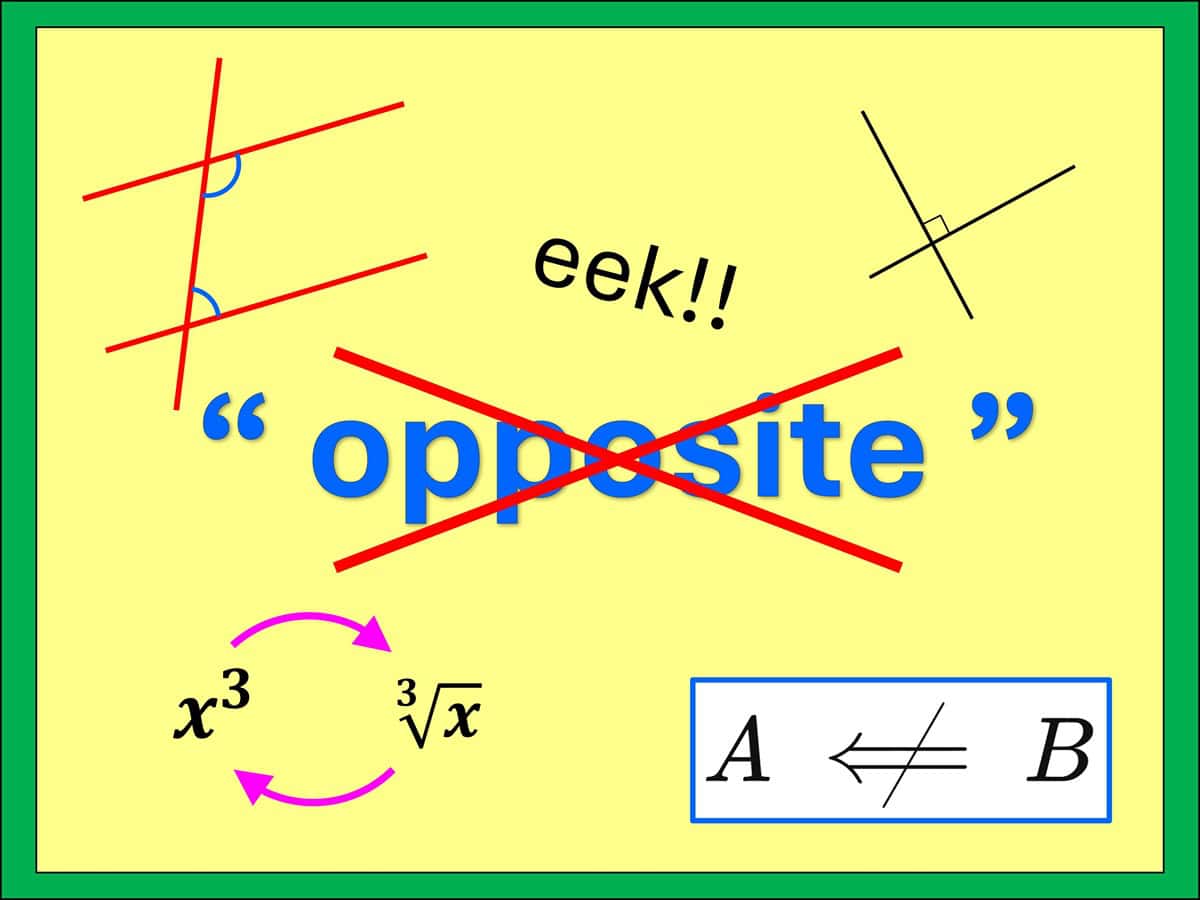
Oh dear – the word “opposite” is usually best avoided in maths: there is almost always a better word or phrase, and sometimes it’s just plain wrong. In everyday language we might use the word “opposite” to describe “no not that, the other thing!” but in maths it pays to be accurate: read on for how things can go wrong!
AT GCSE: Let’s start with three cases where it is actually correct to use the word “opposite”:
1) SOH CAH TOA one side can be opposite a particular angle – or when using the sine rule or cosine rule then angle A is opposite side a.
2) The opposite face of a polyhedron (=a 3D shape made of flat faces stuck together, such as a cube, prism or pyramid) is the face “round the other side” of the shape, and not touching it. For instance, on a cube the top and bottom faces are opposite, as are the front and back, and the left and right.
3) Vertically opposite angles aka diagonally opposite angles: are equal.
And now for some bad examples: at GCSE the word “opposite” could (but ought not to) be used to describe:
Supplementary angles that add up to $180^{\circ}$ – such as angles on a straight line, or co-interior angles (sometimes called allied angles) in parallel lines. NOTE: there is also a correct word complementary for two angles which add up to $90^{\circ}$ (like the two non-right-angles in a right-angled triangle).
The reciprocal. The reciprocal of $x$ is 1 divided by $x$ or $\frac{1}{x}$. It’s like the “opposite” when you are multiplying: when you multiply by $x$ and then by the reciprocal of $x$ you get right back where you started. But please use the correct word reciprocal rather than “opposite”! Check this link for five more uses of the reciprocal.
The negative. This is like the opposite of a number when you are adding or subtracting: when you add $x$ and then add $-x$ you get right back where you started.
The inverse function written $f^{-1}(x)$. This is like the opposite when you apply a function to a number (but not any old function: see below to find out when you can and cannot do this!). For instance, you might say that the opposite of cubing a number is to cube root a number, but it would be better to say that taking the cube root is the inverse of cubing. Other examples you meet at GCSE include the inverse trigonometric functions $cos^{-1}(x)$, $sin^{-1}(x)$ and $tan^{-1}(x)$.
The inverse transformation: for instance the “opposite” of reflecting in the x-axis is reflecting in the x-axis again: do them both and you are right back where you started! You could say that the “opposite” of rotating $90^\circ$ clockwise is to rotate $90^\circ$ anticlockwise (do both to a shape and it is right back where it started) but it’s far better to use the correct term “inverse transformation”.
AT A-LEVEL: the “opposite” could (but shouldn’t!) refer to:
The complement of an event e.g. A is the event “it’s raining”, the complement A’ is the event “it’s not raining”. The probability of a complement is given by P(A’) = 1-P(A)
Integration as the “opposite” of differentiation: I guess this is ok but it’s better to say that integration and differentiation are reverse processes – so one undoes the other.
The negative reciprocal – which is used to find the gradient (=a measure of the steepness or “slope”) of a perpendicular line (i.e. at $90^{\circ}$ to the original line). Oh no -this combines two different types of “opposite” that we discussed earlier – what a muddle! A non-mathematician might say that horizontal and vertical are “opposite”, but a mathematician would prefer to say they are perpendicular i.e. $90^{\circ}$ apart. If a line has gradient $\frac{3}{4}$ then any perpendicular line will have gradient $-\frac{4}{3}$: you flip it and change the sign. Maths students sometimes say “opposite” when they mean the negative reciprocal – make sure you’re not one of them!
The inverse function or inverse transformation: as at GCSE but now we have to be extra careful that the function is one-to-one, or else it is non-invertible and using the term “opposite” will get you into even more trouble than usual. For instance: perhaps you think that square rooting is the opposite of squaring? But if we square the number $-2$ and then square root the answer we get to $2$, not back to the $-2$ that we started with (this is because $\sqrt{x^2}=|x|$ or the modulus of x). Oh what a pickle!
The complex conjugate $z^*$(Further Maths A-level): of a complex number $z$ is the “opposite” of a number in the imaginary direction when adding and subtracting, similar to how the negative of a number is the “opposite” in the real direction when adding or subtracting.
The negation of a statement: this is the sort of “opposite” that causes the most confusion, and is essential to successfully writing a proof by contradiction (A-level year 2). An example:
QUESTION: Prove by contradiction that the sum of a rational and an irrational number is always irrational [this is true!].
ANSWER: let’s investigate what would happen if the statement were false [so far so good…]
So let’s assume that the sum of a rational and an irrational number is always rational.
Oh no! This student has written a different type of “opposite” – instead of the negation they have written the contrary! Read on for a deep dive in “opposite” statements:
AT TMUA (Test in Mathematics for University Admission):
Now we need to be even more careful with logical statements. Take this statement:
STATEMENT: all 6-digit palindromes are multiples of 11. Think of this as A implies B, often written $A \implies B$
Whether or not this statement is true is besides the point, we are merely trying to write the “opposite” – whatever that means! There are several different statements that could all reasonably be called the “opposite” – so let’s be careful and use the correct word! NOTE: some of the following statements are true and some are false!
NEGATION: there exists a 6-digit palindrome that is not a multiple of 11. This is what would happen if the original statement is false. Think of it as A does not imply B, or in mathematical symbols $A \not\Rightarrow B$. It’s the only one you need at A-level. But for TMUA:
CONVERSE: all multiples of 11 are 6-digit palindromes. Think of this is B implies A, or $A \impliedby B$
CONTRAPOSITIVE: If a number is not a multiple of 11 then it’s not a 6-digit palindrome. Think of this as not B implies not A, or $\neg A \not\Leftarrow \neg B$. This turns out to be logically equivalent to the original statement.
INVERSE: if a number is not a 6-digit palindrome then it’s not a multiple of 11. Think of this as not A implies not B, or $\neg A \implies \neg B$
CONTRARY: all 6 digit palindromes are not multiples of 11 (or “no 6 digit palindromes are multiples of 11″). Think of this as A implies not B, or $A \implies \neg B$