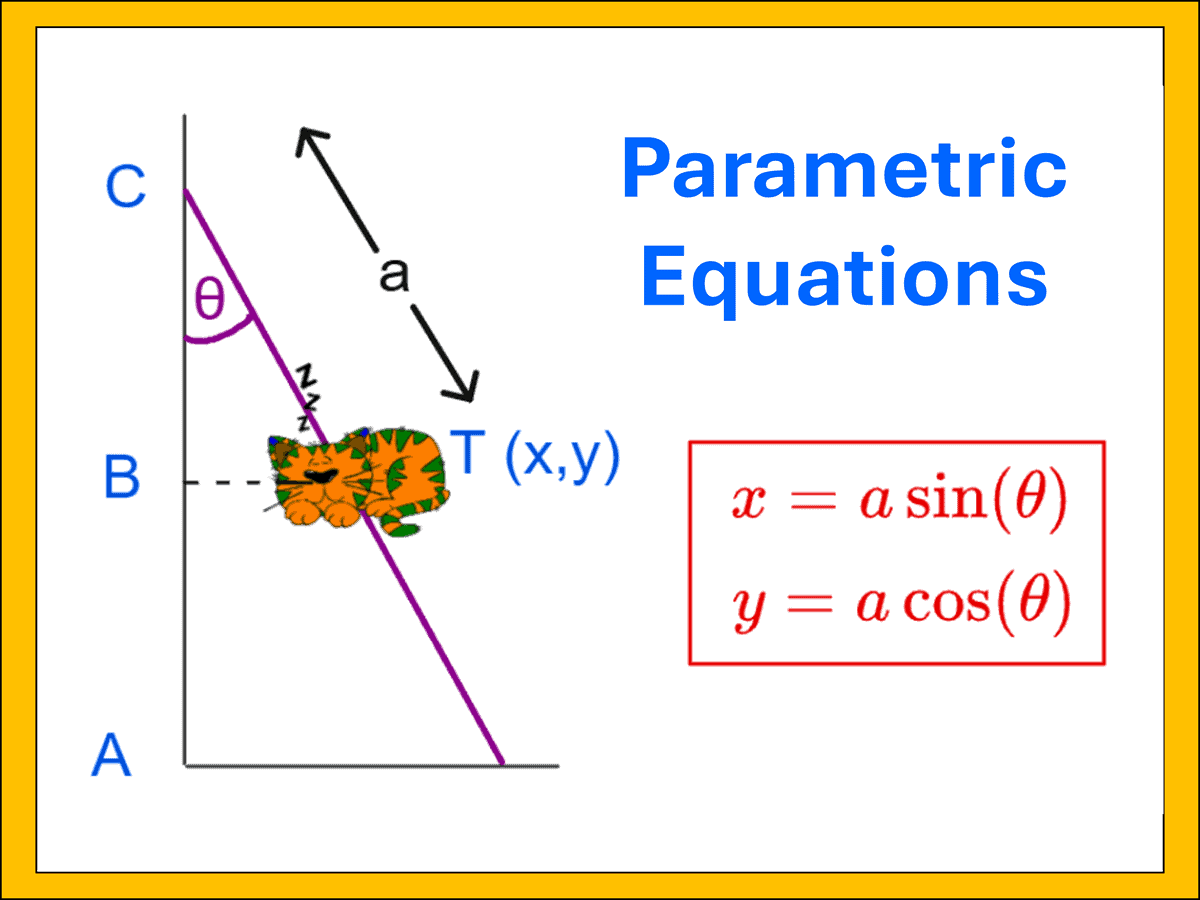
AT A-LEVEL: in Year 1 of A-level we seem to be fine with the regular $x,y$ or “Cartesian” equations of curves e.g. $y=x^2$ is a parabola, or $(x-a)^2+(y-b)^2=r^2$ is a circle. And then in Year 2: BAM! along comes the Parametric Equation of a curve! Why bother? Simply because it allows us to describe and analyse a much larger class of curves! Here’s a simple example:
CAT ON LADDER CASE 1: Tiptoes the Cat sees a ladder propped up against a wall, leaps up onto the middle rung (halfway up the ladder) and settles down for a good catnap. To his horror, the ladder starts to slip down the wall, moving faster and faster until KERBLAM it crashes to the floor, coming to rest lying horizontally with a very cross Tiptoes still clinging to the middle rung. Our puzzle is to describe the path that Tiptoes describes as the ladder falls to the floor. Is it a straight line? Parabola?? Something else???
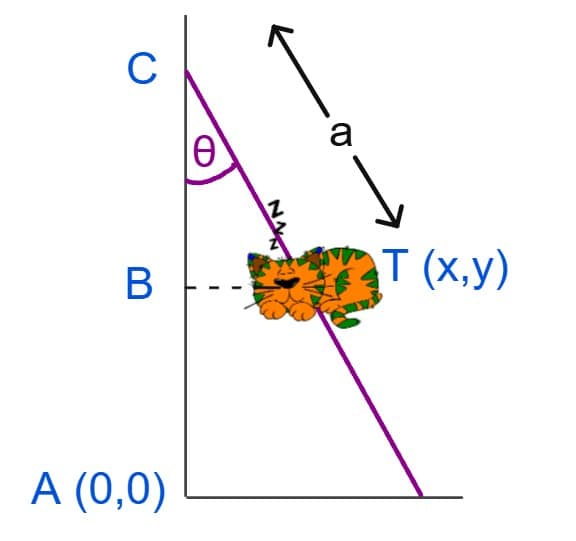
SOLUTION: measure coordinates from the bottom left, where floor meets wall. Suppose the ladder has length 2a, and makes an angle of $θ$ with the wall. Tiptoes starts at $θ\approx 0^{\circ}$ with the ladder nearly vertical, and ends at $θ=90^{\circ}$ when the ladder crashes into the ground. Using SOHCAHTOA, the $x$ and $y$ coordinates of our feline hero are:
$x=BT=a\sin(θ)$ and
$y=AC-BC=2a \cos(θ)-a\cos(θ)=a\cos(θ)$.
$\left.
\begin{array}{l}
x=a \sin(θ) \\
y=a \cos(θ)
\end{array}
\right\}
\quad 0 < θ \leq 90^{\circ}
$
We call these the parametric equations of the curve, because each of x and y are given in terms of a third variable, the parameter (the letter chosen for the parameter is often $t$ but in this case I’m using $θ$ as it represents an angle). We can now eliminate the parameter from our equations to get the familiar Cartesian equation of Tiptoes’ path: square and add the equations for $x$ and $y$, factor out $a^2$ and notice that $\sin^2(\theta)+\cos^2(\theta)\equiv 1$ (the well known trig identity) to end up with:
$x^2+y^2=a^2$
We recognise this as the equation of a circle: so Tiptoes moves in a circular path (actually a quarter-circle).
AT FURTHER MATHS A-LEVEL: let’s try a slightly harder variation:
CAT ON LADDER CASE 2: what happens if Tiptoes is on a different rung of the ladder, a distance $d$ from the top of a ladder of length $l$, like in this picture?
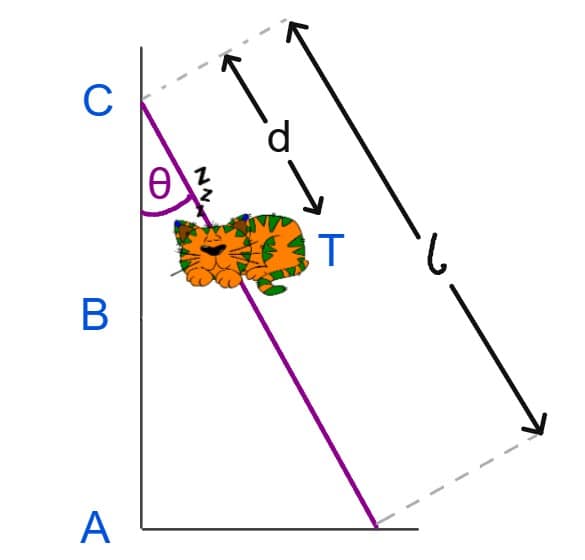
SOLUTION: Now our parametric equations for Tiptoes become:
$\left.
\begin{array}{l}
x=d \sin(\theta) \\
y=l \cos(θ) – d \cos(\theta)
\end{array}
\right\}
\quad 0 < θ \leq 90^{\circ}
$
Writing $\sin(\theta)=\frac{x}{d}$, $\cos(\theta)=\frac{y}{l-d}$ and again using $\sin^2(\theta)+\cos^2(\theta)\equiv 1$ to eliminate $\theta$, this time we get:
$\left( \frac{x}{d} \right)^2 + \left( \frac{y}{l-d} \right)^2 = 1$
and students of FP1 “Further Pure 1” will recognise this as the Cartesian equation of an ellipse!
VIDEO DEMONSTRATION: It’s quite hard to visualise the circle and ellipse, so here is 33 seconds of video to demonstrate how the path plays out for various positions of the cat. To create the video I had to use the parametric equations: the Cartesian equations just didn’t have the flexibility to be able to demonstrate the moving path. Enjoy!